What Is an Intelligent Servo Hoist and How Does It Work?
An intelligent servo hoist is a motorized lifting device that uses a servo motor with closed-loop electronic control — instead of a conventional induction motor — to deliver precise, variable-speed lifting. If you run a factory and are wondering whether servo technology is worth the investment, this article explains what it actually does and how it works.
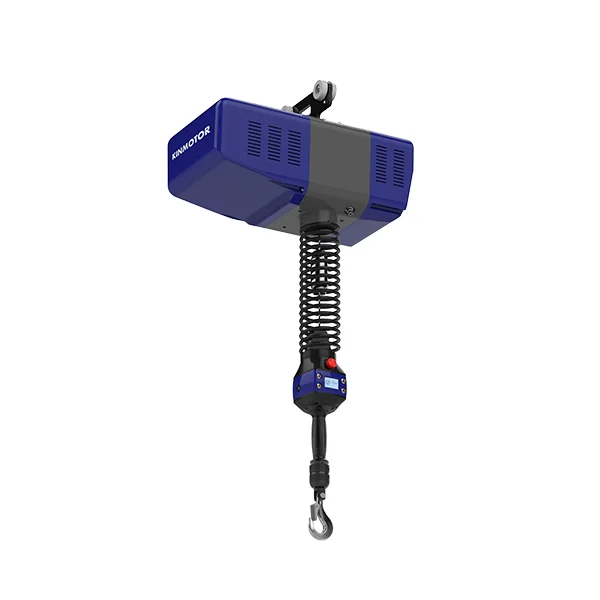
The Core Idea: Servo Motor Replaces Induction Motor
A traditional electric hoist uses an induction motor — the same basic technology that powers a ceiling fan. It spins at a fixed speed. You get two speeds if you're lucky: high and low. The motor doesn't know where the hook is, how heavy the load is, or whether it's about to hit the ceiling.
An intelligent servo hoist replaces that induction motor with a servo motor — the same type used in CNC machines and industrial robots. A servo motor has a built-in encoder that continuously reports its exact position, speed, and torque to a control processor. The processor adjusts the motor's output thousands of times per second.
In practical terms: an operator can lift a 300 kg sheet of steel at 30 meters per minute across the workshop, then slow to 0.05 meters per minute for millimeter-precise placement on a laser cutting table — all in one continuous motion, without switching gears.
How Closed-Loop Control Works
The defining feature of a servo hoist is closed-loop control. Here's the simplified sequence:
- The operator moves the handle. A sensor in the handle detects the direction and amount of force applied, then sends a signal to the control processor.
- The processor calculates the required motor output. Based on the handle input, current load weight (measured in real time), and position data, the processor determines exactly how much power to send to the motor.
- The servo motor executes — and reports back. The encoder continuously feeds position and speed data back to the processor, creating a feedback loop.
- The processor corrects in real time. If the load drifts or the speed deviates from the target, the processor adjusts output instantly — thousands of times per second.
This is fundamentally different from a traditional hoist, where the motor simply runs at its rated speed and the operator compensates with experience and guesswork.
The Five Technologies That Make It "Intelligent"
1. Stepless Speed Control (0.05–30 m/min)
A traditional hoist has fixed speed gears — typically one or two. A servo hoist has a continuous speed range. The operator controls speed by how far they push the handle, not by selecting a gear. This means you can move fast through open space on the shop floor, then slow to a crawl for precise placement — all in one motion.
2. Zero-Speed Start
When a traditional hoist starts, the motor engages at full speed immediately — causing a sudden jerk. This is why loads swing when lifting begins. A servo hoist starts from zero speed and accelerates smoothly. For handling polished sheet metal, glass, or precision components, this eliminates surface damage from sudden movement.
3. Electronic Overload and Anti-Rebound Protection
The control processor monitors the load weight continuously. If the load exceeds the rated capacity, the hoist refuses to lift and triggers an alarm. Anti-rebound protection prevents the hook from bouncing back if the load is suddenly released — a common safety hazard with traditional hoists.
4. Multi-Mode Operation
Intelligent servo hoists support multiple control modes on the same unit:
- Handle mode: The operator grips the handle directly attached to the hoist. Sensors detect applied force — push up to lift, push down to lower.
- Suspension mode: The hoist is controlled via a pendant or remote. Used when the operator stands away from the load.
- Wireless mode: Remote control for maximum operator mobility and safety.
5. Soft Limit and Position Memory
The control processor can memorize upper and lower travel limits. When the hook approaches a limit, it decelerates smoothly rather than hitting a mechanical stop. Some models can store multiple preset positions — useful in repetitive production tasks like loading the same part onto a CNC fixture repeatedly.
Wire Rope vs. Chain: Which Servo Hoist Structure?
Intelligent servo hoists come in two mechanical structures:
| Feature | Chain Type | Wire Rope Type |
|---|---|---|
| Max Speed | Up to 16 m/min | Up to 30 m/min |
| Precision | Good | Excellent (millimeter-level) |
| Durability | High (chain resists abrasion) | High (steel cable, needs periodic inspection) |
| Best For | General manufacturing, assembly | Laser cutting, CNC loading, high-cycle operations |
| Kinmotor Series | D3, Q6 (125–600 kg) | X3 (125–600 kg) |
Wire rope hoists achieve higher linear speeds because the cable wraps around a drum, while chain hoists are limited by chain-link engagement speed. For applications where cycle time matters — like laser cutting sheet loading — the wire rope X3 series is the recommended choice.
When Does a Servo Hoist Make Sense?
A servo hoist costs more upfront than a traditional hoist. It's not the right choice for every application. Here's a practical framework:
Consider a servo hoist if:
- You handle loads that require precise positioning (sheet metal onto a laser bed, molds into a press, parts onto a CNC fixture)
- Your cycle time matters — switching speeds mid-operation saves seconds per cycle, which adds up to hours per week
- Operator safety is a priority — zero-speed start and anti-rebound reduce workplace injuries
- Load surfaces must not be damaged — smooth acceleration prevents scratches and dents
Stick with a traditional hoist if:
- You're lifting the same weight to the same height repeatedly with no precision requirement
- Budget is the primary constraint and cycle time is not a bottleneck
- The hoist is used infrequently (a few times per day)
For many small to medium manufacturers, the productivity gains from a servo hoist can justify the higher purchase price through faster cycle times, more controlled handling, and reduced risk of product damage.
Kinmotor's Approach
Kinmotor's hoist development is built around in-house servo motor expertise. The parent company, Zhejiang New Folinn Co., Ltd., is a national high-tech enterprise specializing in servo motor R&D and manufacturing.
This vertical integration means the motor and the hoist are designed as a single system — not a generic motor bolted onto a hoist frame. The result is tighter integration between the control processor, encoder feedback, and mechanical components.
Kinmotor's servo hoist lineup covers the full range of light industrial applications:
- X3 Series — Wire rope, 30 m/min, 125–600 kg. Recommended for high-cycle operations where lifting speed matters.
- D3 Series — Chain, 16 m/min, 125–500 kg. General-purpose with photoelectric safety sensor.
- Q6 Series — Chain, 16 m/min, 100–600 kg. Wide capacity range with optional wireless.