Servo vs Traditional Electric Hoist: 5 Key Differences That Matter
If you're evaluating hoists for your factory, you've probably noticed that servo hoists cost more. This article breaks down exactly what you're paying for — and when the investment makes sense.
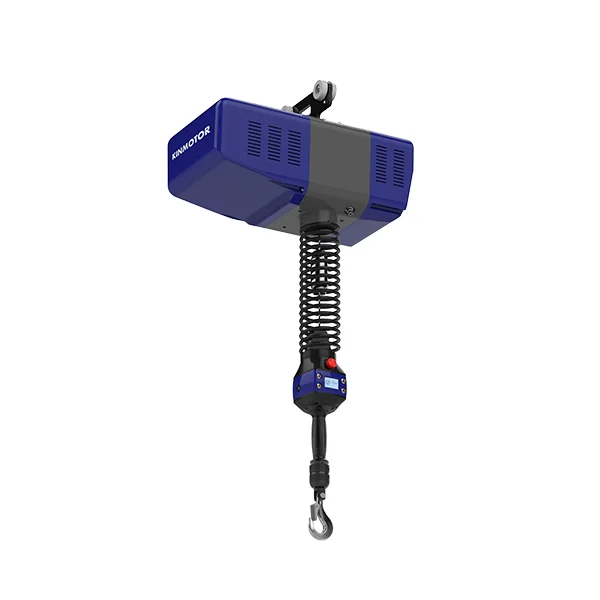
The Short Version
A traditional electric hoist is a motor that lifts. A servo hoist is a computer-controlled lifting system that knows where the hook is, how heavy the load is, and how fast it should move — and adjusts itself thousands of times per second.
The price difference is real. But so are the productivity gains. Here are the five differences that actually matter on a shop floor.
Difference 1: Speed Control — Stepless vs. Fixed Gears
| Traditional Hoist | Servo Hoist |
|---|---|
| 1–2 fixed speeds (high/low gear) | Continuous stepless range (0.05–30 m/min) |
| Must stop to change speed | Speed changes continuously during motion |
| "Fast enough" or "slow enough" — no middle ground | Any speed between minimum and maximum, at any moment |
Shop floor impact: An operator loading sheets onto a laser cutter spends about 2 seconds in fast travel across the shop and another 3 seconds in slow approach for precise placement. With a traditional hoist, those are two separate operations with a gear change in between. With a servo hoist, it's one continuous motion — saving 1–2 seconds per cycle. At 20 cycles per hour, that's 20–40 minutes saved per shift.
Difference 2: Positioning Accuracy — Millimeter vs. Centimeter
| Traditional Hoist | Servo Hoist |
|---|---|
| Open-loop control — motor runs, operator judges position by eye | Closed-loop control — encoder reports exact position to processor |
| Accuracy depends entirely on operator skill | Consistent millimeter-level accuracy regardless of operator |
| Common to bump, overshoot, and reposition | Soft limit deceleration prevents overshoot entirely |
Shop floor impact: In a precision machining shop, placing a 200 kg mold onto a CNC fixture requires accuracy. With a traditional hoist, the operator taps the button in short bursts — "inching" the load into position. With a servo hoist, the operator moves at normal speed until 5 cm from the target, then the handle naturally controls micro-speed for final placement. No tapping, no bumping, no repositioning.
This matters most in applications where the load or the fixture is expensive. A scratched mold or a dented sheet metal panel costs more than the hoist upgrade.
Difference 3: Safety — Active Protection vs. Passive Limits
| Safety Feature | Traditional Hoist | Servo Hoist |
|---|---|---|
| Overload protection | Mechanical clutch (slips at ~125% rated load) | Electronic sensor — refuses to lift beyond rated capacity |
| Start behavior | Instant full-speed — causes load swing | Zero-speed start — smooth, no swing |
| Anti-rebound | Not available | Electronic brake holds position if load suddenly released |
| Power failure | Mechanical brake engages (load drops slightly) | Electromagnetic brake + power-off holding — no drop |
| Upper/lower limits | Mechanical limit switch — abrupt stop | Soft limit — decelerates smoothly before stopping |
Shop floor impact: The overload protection alone has real financial consequences. A traditional hoist's mechanical clutch allows brief overload — enough to damage a load or strain the hoist. The servo hoist simply refuses to lift. For workshops with multiple operators of varying experience levels, this electronic safeguard prevents the most common cause of hoist damage: someone trying to lift more than the rated capacity.
Difference 4: Energy Efficiency — Demand-Based Power Use
A traditional induction motor draws near-full power whenever it's running — even when lowering a load. A servo motor draws power proportional to the work being done.
In a typical sheet metal shop operating one hoist for 6 hours per day, the energy savings from a servo hoist amount to approximately 1,200–2,000 kWh per year. At industrial electricity rates, that's $150–$300 per year — not transformational on its own, but it contributes to the total cost of ownership calculation.
The bigger energy benefit is indirect: a servo hoist completes each lift cycle faster, so the motor runs for fewer total hours per day to accomplish the same work.
Difference 5: Total Cost of Ownership
This is where most comparisons go wrong. They compare purchase price. The correct comparison is total cost over the hoist's service life.
| Cost Factor | Traditional Hoist | Servo Hoist |
|---|---|---|
| Purchase price | Lower | Higher (1.5–2×) |
| Typical service life | Varies by model and duty cycle | Designed for long service life |
| Maintenance frequency | Regular brake/clutch wear replacement | Low — fewer mechanical contact points |
| Downtime risk | Higher — mechanical wear predictable but frequent | Lower — electronic diagnostics detect issues early |
| Operator training | Requires experienced operator for precision work | New operators achieve precision within days |
| Product damage risk | Higher — jerky starts, overshoot | Lower — smooth control, precise placement |
| 5-year TCO (estimated) | Purchase + 2–3 brake replacements + downtime | Purchase + minimal maintenance + productivity gain |
The real math: For a workshop running one hoist at moderate duty (4–6 hours/day), the servo hoist's higher purchase price should be evaluated against:
- Faster cycle times (10–20% productivity gain per operator)
- Reduced risk of product damage during lifting and placement
- Lower maintenance costs (fewer brake/clutch replacements)
- Longer service-life potential when matched to the correct duty cycle
When a Traditional Hoist Still Makes Sense
This article advocates for servo technology — but here are the honest cases where a traditional hoist is the right call:
- Infrequent use. If the hoist runs a few times per day for basic lifting tasks, the productivity gain from servo speed control is negligible.
- No precision requirement. If you're lifting scrap bins or moving raw material pallets, centimeter accuracy is fine.
- Capital-constrained startup. A traditional hoist gets you operational. You can upgrade later.
- Extremely heavy loads. Above 2,000 kg, servo hoists are less common and traditional industrial hoists dominate.
Kinmotor Servo Hoist Options
Kinmotor offers three servo hoist series covering different speed, precision, and budget requirements:
| Series | Type | Capacity | Max Speed | Best For |
|---|---|---|---|---|
| X3 | Wire Rope | 125–600 kg | 30 m/min | Laser cutting, high-cycle CNC loading |
| D3 | Chain | 125–500 kg | 16 m/min | General manufacturing, assembly |
| Q6 | Chain | 100–600 kg | 16 m/min | Wide-range applications, wireless option |
For workshops that need servo-level speed control but prefer a lower-cost chain-based system, the D2 VFD Chain Hoist offers variable-frequency stepless speed without the full servo price — a middle ground worth considering.